Not Every Company Needs AI
AI transformation is not a universal imperative. For some businesses the honest answer is "not yet," and pretending otherwise wastes capital, distracts the team, and can damage what already works.
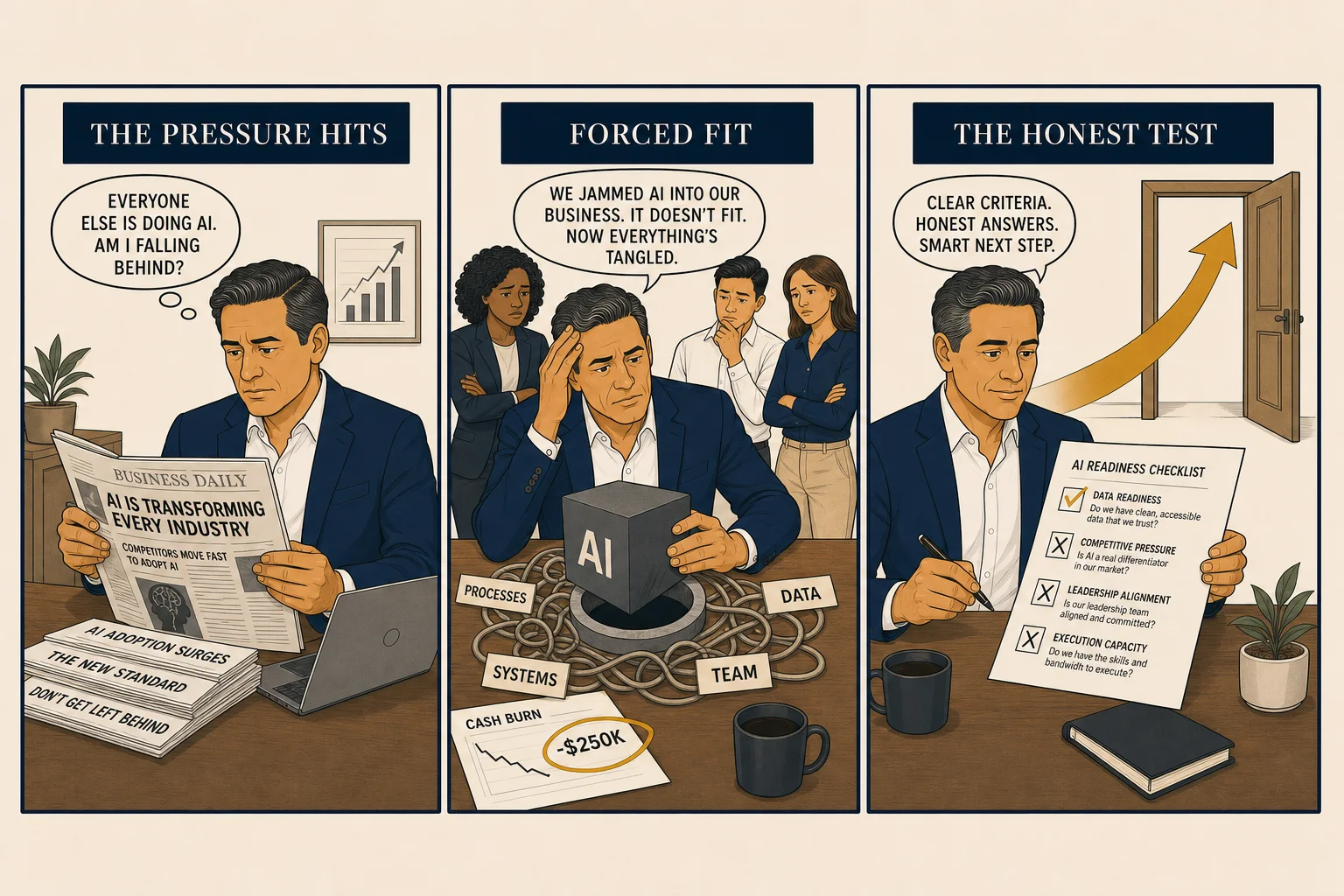
The loudest message in business right now is that every company must transform with AI immediately or die. That message is mostly being sold by people who profit when you act on it. The truth is quieter and more useful: AI can be transformational for the right business at the right time, and a distraction or an outright mistake for the wrong one. Pilot programs fail at high rates, often quoted between seventy and ninety-five percent on the way to real value. For many companies the foundational work comes first, and the most valuable thing this wiki can tell you is when to wait.
Who should slow down
A few patterns show up repeatedly in businesses that should deprioritize a full transformation.
Small and simple operations. If your processes are straightforward, already efficient, and do not involve heavy repetitive data work, AI usually adds cost and complexity without clear return. Local trades, small retail, personal services, and artisanal makers are better served by disciplined execution, customer relationships, and cash flow than by a transformation program. Tactical automation inside tools you already own is fine. A transformation is not.
Stable cash cows on thin margins. In low-disruption industries where the core model works reliably, the upfront investment in data, talent, and change management rarely moves the needle enough to justify diverting attention from a proven operation.
High-stakes human-judgment domains with low data readiness. Certain healthcare, legal, elder-care, and specialized-counsel businesses run on empathy, ethics, liability, and trust. There, hallucination and compliance risk are expensive, and human accountability is the moat. AI can undermine it without heavy safeguards.
Companies without leadership alignment or cultural readiness. Roughly seventy percent of failures are people and process failures, not technology failures. Without top-down commitment, decent data hygiene, and a clear use case tied to revenue, AI becomes a siloed experiment that produces disillusionment instead of value.
Relationship-driven businesses where human connection is the product. High-touch services, certain creative fields, and bespoke or premium experiences risk commoditizing the very thing that makes them special.
The honest test
The question is never "should we do AI." It is "does this solve a specific, high-impact problem with measurable return, or is it hype-driven." A company with a data advantage, scalable processes, competitive pressure, and leadership ready to treat AI as an operating-model shift should move hard. A company without those is usually better off fixing fundamentals first. Knowing which one you are is itself the first deliverable, and it is exactly what an honest discovery process is for.
The repricing is still happening to you
Waiting is not the same as escaping the valuation pressure described in AI Now Decides What You're Worth. Buyers and investors are repricing businesses based on AI-readiness whether or not you participate. "Not yet" does not make that dynamic disappear.
What it does is clarify the response. If your processes are unproven and undocumented, a rushed AI implementation signals execution failure to any sophisticated buyer — it does not demonstrate AI leverage. The correct answer to repricing pressure, when you are not yet ready, is to get ready: document the processes, prove they work, build the foundation the transformation would run on. That is real preparation for a higher multiple, and it starts before the first AI tool is purchased.
Further reading
Source: House of El, "Big Tech CEOs AI Psychosis Is A Total Disaster."