Inertia and Chaos: Why Transformations Stall
Every performance gap has one of two causes: inertia (compliance with bad rules) or chaos (non-compliance with good rules). They need opposite fixes, and almost nobody runs the test that tells them apart.
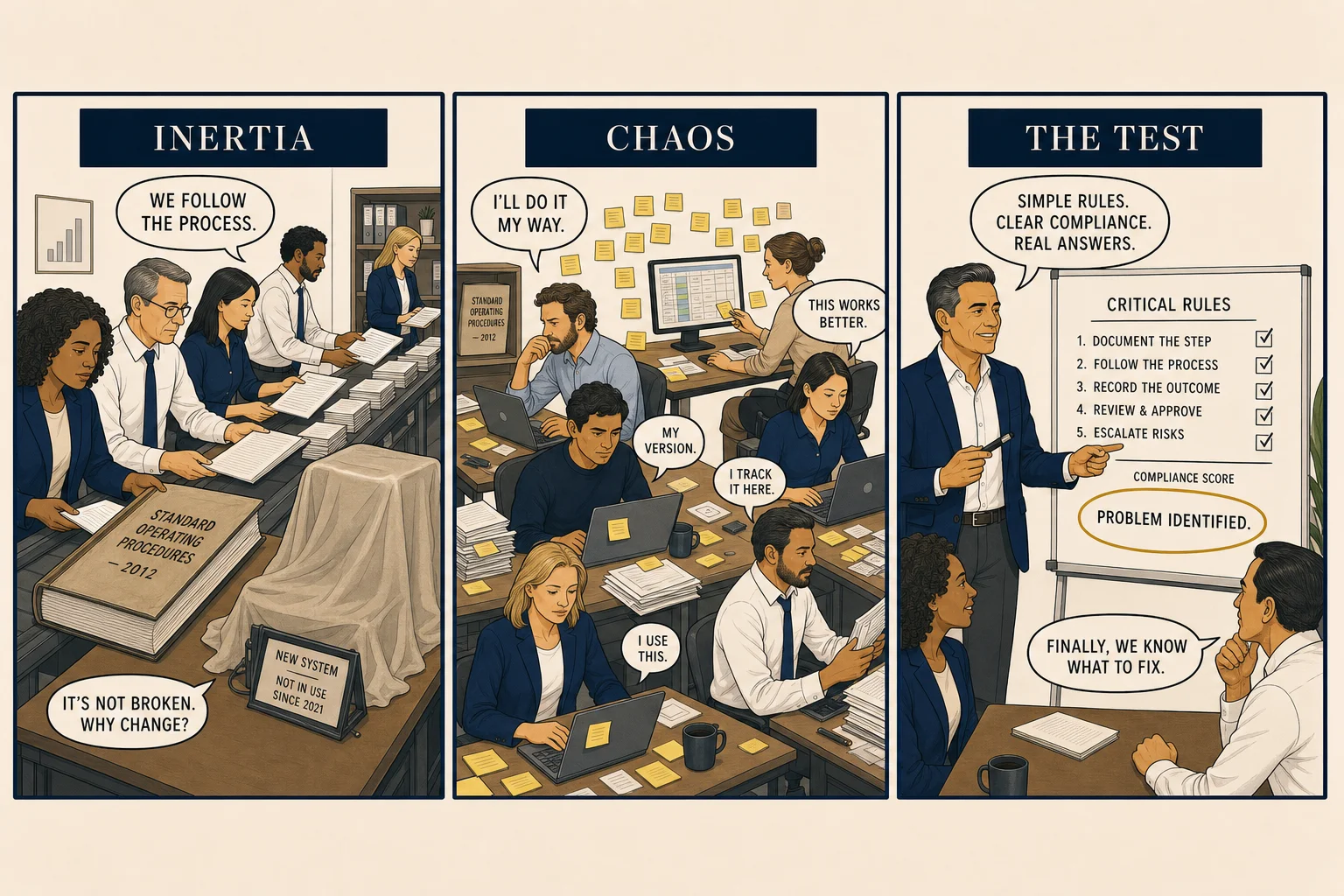
Two causes, opposite fixes
When an operation underperforms, the gap traces to one of two failure modes.
Inertia is when people follow the old rules faithfully even though the rules have outlived their reason. "We've always done it this way." The compliance is excellent. The rules are the problem.
Chaos is when people stop following rules that work. Workarounds, side spreadsheets, local shortcuts that quietly become the real process. The rules are fine. The non-compliance is the problem.
Both are leadership failures, not people failures. Inertia means leadership never made it safe to challenge the status quo. Chaos means leadership tolerated non-compliance, or incentivized it through metrics that reward local optima over the whole.
The diagnosis matters because the fixes point in opposite directions. Inertia needs new rules. Chaos needs new discipline. Aim the fix at the wrong one and you make things worse: tighten discipline on a bad rule and you accelerate the harm; rewrite rules nobody was following and nothing changes.
The test almost nobody runs
You cannot tell inertia from chaos by gut. The test, from Theory of Constraints practitioner Dr. Alan Barnard, is simple: identify the critical planning and execution rules in your area, then measure compliance to them.
High compliance with bad results means inertia. The team is doing exactly what the system asks, and the system is asking for the wrong thing. Low compliance means chaos, and the question becomes why the incentives reward going around the rules.
Frame this as diagnosing the system, not policing people. The point of measuring compliance is to find bad rules at least as much as bad compliance. Tell the team that directly: we are measuring to learn whether our underperformance comes from not following good rules or from faithfully following bad ones.
Inertia is the default, not the exception
Eliyahu Goldratt, whose The Goal anchors the bottleneck argument in this wiki, considered inertia important enough to make it the fourth and final pillar of Theory of Constraints: never say "I know." He added it in the last month of his life. Three weeks before he died, he gathered forty of his top practitioners at his home and spent a meaningful share of his remaining teaching hours on inertia alone.
His warning was specific: experts are the most susceptible. Success teaches you to stop questioning your own playbook. The more times your way of operating has worked, the less likely you are to notice when the conditions that made it work have changed. Most organizations only re-examine their rules when a crisis forces it, which is why "crisis is the mother of innovation" is true and also an indictment.
This is the mechanism behind the three questions. The rules that outlive their limitation do not survive because anyone re-endorsed them. They survive because nobody felt safe asking whether they still made sense.
The two responsibilities
The escape from inertia without falling into chaos is a pair of duties every employee should hold:
- Follow the agreed rules. The global-optima rules exist so the whole system performs, not just one desk.
- Speak up when a rule would cause harm. If local knowledge says following a rule will hurt the company or its stakeholders, the employee has both the right and the responsibility to escalate: name the harm, propose the change, get feedback from the stakeholders the change touches.
Nobody gets to quietly break a rule on their own judgment. That is chaos. And nobody should suffer for challenging a rule through the proper channel. Punish one person for speaking up and the whole organization learns to stay silent, which is how inertia compounds.
The classic example: a rule bans overtime because of budget pressure, and someone on the floor can see the ban is about to cause stockouts and lost sales worth far more than the overtime. Escalating that is not insubordination. It is the job.
Why this decides AI transformations
AI transformation is rule-changing work. The whole point is that a category of rules built around an old limitation, steps that required a human because machines could not reason, can now be rewritten.
Inertia is why those rules survive the limitation. An organization that has never made it safe to challenge its own rules will deploy AI inside the old rules and get nothing, which is the MRP story repeating on schedule.
Chaos is the failure on the other side, and it has a current form: shadow AI. Teams adopting tools off-book because local metrics reward it, with no shared rules about what the system of record is. Deploy an official transformation on top of that and you are automating a process nobody actually follows.
So before transforming, run the compliance test. It tells you whether you need new rules or new discipline, and it tells you what the transformation is actually up against. AI deployed onto the wrong diagnosis does not fix the failure. It automates it.
Further reading
- Three Questions to Ask Before AI Transformation
- Transformation Done Wrong Breaks What Works
- What AI Transformation Actually Is
- Data Is Not Actionable Signal
Sources: Rami Goldratt, "The 4 Pillars of Theory of Constraints" (Goldratt Consulting); Dr. Alan Barnard on inertia, chaos, and rule compliance.