Get Clarity Before You Transform
Do not hire anyone to transform your business until you have a ranked, ROI-backed map of what is actually worth doing, because clarity first is what makes every dollar of spend defensible.
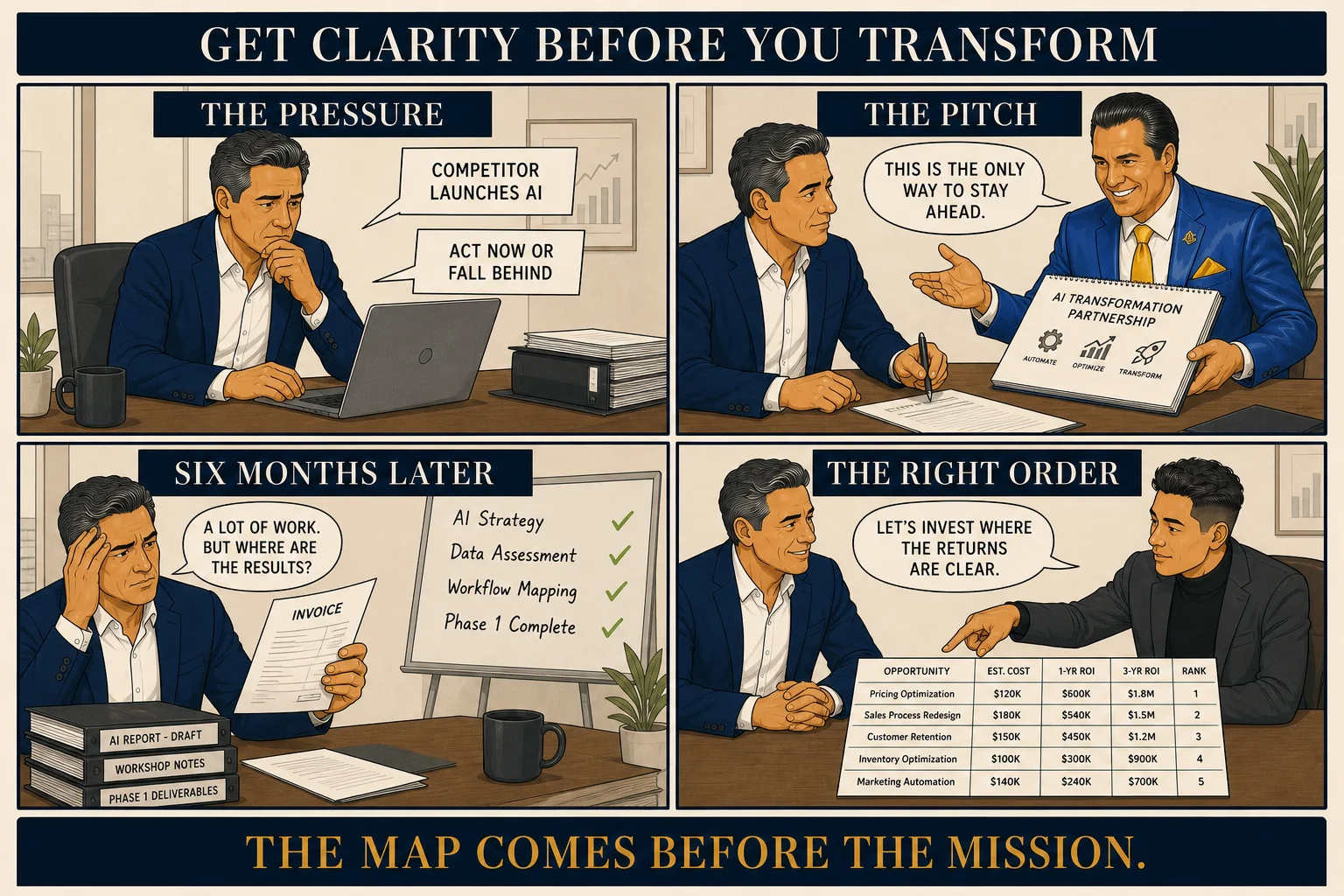
The most common mistake owners make with AI is not spending too little or spending too much. It is spending before they know what they are buying. They feel the pressure, they hear the pitches, and they hand a transformation partner a blank canvas and a budget. Six months later they have impressive demos and no clear answer to the only question that matters: did this move the value of the business, and by how much.
The fix is unglamorous and it comes first. Get clarity before you transform.
The Map Comes Before the Mission
You would not let a contractor start knocking down walls before you had a blueprint and a number. AI transformation deserves the same discipline, and most owners skip it because the contractor is happy to start without one.
Clarity here means something specific. It is a ranked list of the places AI could change your business, each one tied to an honest estimate of what it costs to do and what it is worth if it works. Not a wish list. A prioritized map where the top items are the ones with the highest return and the lowest risk, and the bottom items are the ones you can see are not worth it. This is the same instinct behind gap analysis for exits and Snider's value-acceleration discipline in Walking to Destiny, where you assess and rank before you act, and you act on what the assessment told you, not on what is exciting.
Without that map, every conversation with a partner is a negotiation you are losing, because they know what is worth doing and you do not.
Clarity Is What Makes the Spend Defensible
The deeper reason to get clarity first is accountability. The moment you have a ranked, ROI-backed map, every dollar you spend becomes defensible. You can say to a board, a co-owner, or your own future self: we did this initiative because it ranked first, it cost roughly this, and it was worth roughly that, and here is the result against the estimate.
That sentence is the difference between an investment and a gamble. It is also what separates an operator from a hobbyist, and disciplined, attributable spend is itself a signal of quality. The proof ends up in your numbers rather than in your pitch.
The absence of clarity does the opposite. Undefended spend reads as exactly what it is, money chasing a trend, and it undermines the very value story you were trying to build.
Clarity Protects You From the Partner
There is a flood of transformation partners coming, and their incentives do not perfectly match yours. A partner generally makes more when the engagement is bigger and longer, regardless of whether the biggest, longest version is the right one for you. That is not a knock on partners. It is just the structure.
Clarity is your protection against that structure. When you walk in with your own ranked map, the conversation changes. You are no longer asking "what should I do," which invites the most expensive possible answer. You are asking "here is what we have determined is worth doing and in what order, can you execute it, and where do you disagree." That is a conversation you control, and it is the foundation of being able to choose a transformation partner well rather than being chosen by one.
Notice that the clarity has to be partner-agnostic to do its job. A map drawn by the same firm that will be paid to execute it is not a map, it is a quote. The value of clarity comes precisely from the fact that it was built independent of who profits from the answer.
Clarity Is Cheap Compared to What It Saves
The objection is that doing the clarity work first feels like a delay, another step before the real work. But the clarity step is a rounding error next to the transformation budget it governs, and getting it wrong is what is actually expensive. A few weeks of rigorous prioritization routinely reroutes six and seven-figure spend away from the wrong initiatives and toward the ones that actually move the business. The cheapest dollar you will spend on transformation is the one you spend deciding what not to do.
If you take one thing from this page: the order is clarity, then transformation. Do them in that order and every later step gets easier and more defensible. Do them out of order and you pay for the lesson at the worst possible time.
A ranked, ROI-backed map of your specific business is exactly what the Agentic Business Blueprint Intensive at builtforexit.ai is built to produce. Think of it as the blueprint you build your value-maximized company from, drawn before anyone is paid to swing a hammer.
Further reading
- How to Choose a Transformation Partner
- Transform Before You Exit
- AI Now Decides Your Multiple
- Gap Analysis for Exits
- Value Acceleration Methodology
Sources: Snider, Walking to Destiny; Built for Exit, "The Writing On the Wall."