What a Transformed Company Looks Like
The destination: a business that knows its own state in real time, flags its own improvement opportunities, and routes leadership energy to the highest-leverage decisions.
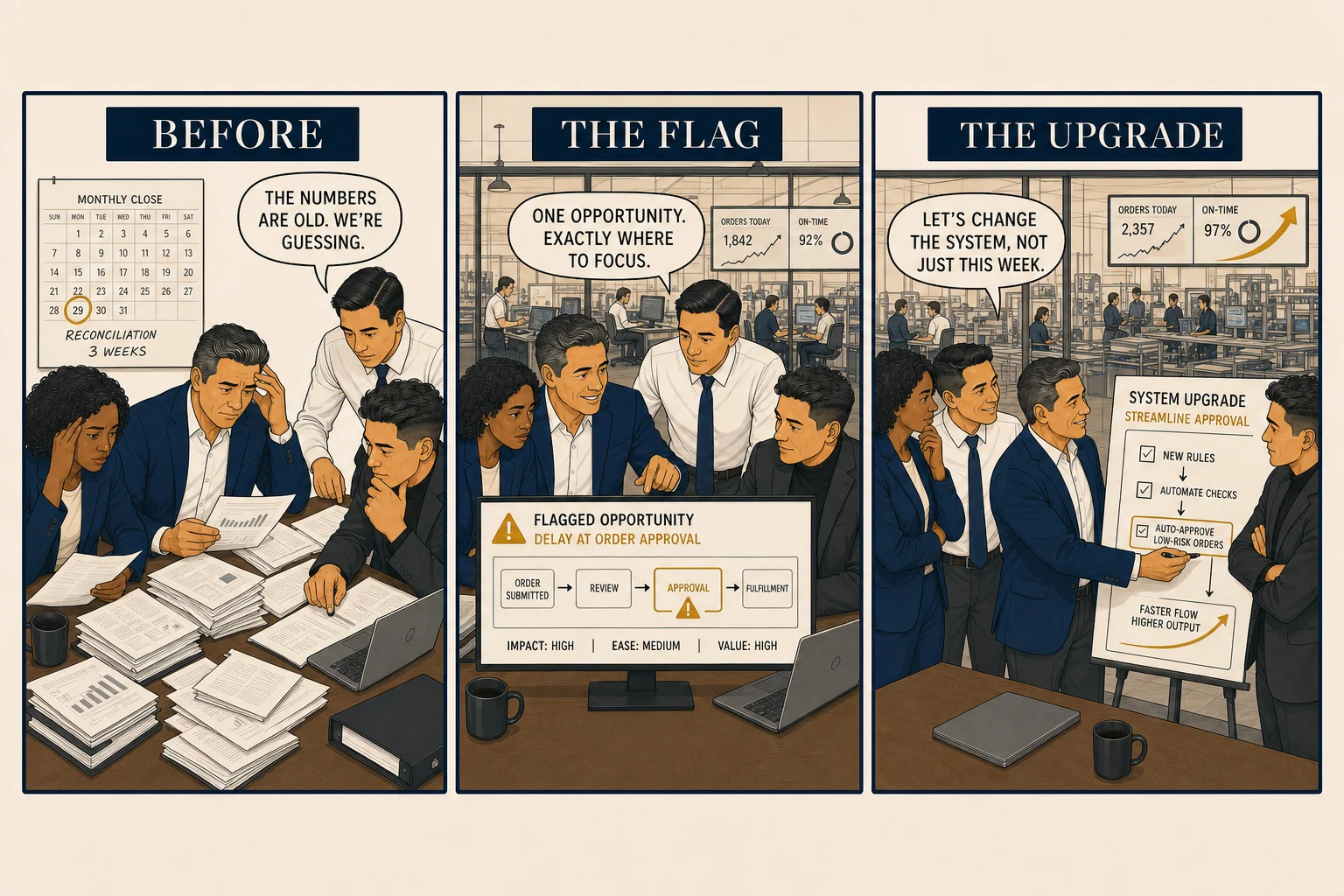
The day-to-day, after
Most writing about AI transformation describes the journey and never the destination. Here is the destination.
In a transformed company, leadership's day-to-day changes shape. Instead of waiting thirty days for reconciled numbers and hunting through reports for what needs attention, leaders work from what the business surfaces: current state in real time, and flagged opportunities to improve the system. A metric drifting from target. A bottleneck forming. A question worth a discussion.
The flag is not the end of the process. It convenes one: signal, then discussion, then action, then a measurable improvement to how the business runs. That loop, running continuously, is what a transformed company actually is. Not a stack of tools. A business that participates in its own improvement.
This is data as actionable signal, operating as designed.
The maturity ladder
The transformation consultant Walker Reynolds, who has spent two decades wiring up manufacturers, describes the end state in one sentence: everything and everyone is plugged into the network, and every layer of the business operates on real-time data from every other layer. The ladder to get there:
- Know current state in real time. Stakeholders at every level see what is happening now, not last month. This alone is a three-to-five-year journey for most companies, and it is the first milestone, not the finish line.
- Predict future state. With current state historized, machine learning finds patterns people cannot see and projects where things are heading: this is where the shift lands, this is the order that will slip.
- Recommend adjustments. AI proposes the operational change that improves the projected outcome.
- Humans decide. Stakeholders execute or decline the recommendation. The judgment stays human. The hunting does not.
Each rung exists to speed up one thing: the time from data to a decision that optimizes the business. Reynolds is blunt about it: the point of transformation is not dashboards. A dashboard nobody acts on is decoration.
The questions change as the company matures
The sharpest way to see the destination is to watch what questions leadership gets to ask.
Early, the questions are operational and reactive: do we ship today, will this shift hit its target, which orders are at risk. Necessary questions, answered faster.
In a mature transformed company, the questions climb: why does this problem keep recurring? Which of our constraints is actually worth removing? Where should we invest the next million dollars? These are system-improvement questions, and they are only askable because the operational layer answers itself. The business handles the loops; leadership interrogates the system. That is the high-leverage posture the whole transformation exists to produce.
A useful test of any transformed company: listen to what its executives spend their meetings on. If it is still "what happened last month," the transformation has not arrived, whatever the tooling says.
Every number answers a question. Every question serves a decision.
In a transformed company, nothing is displayed because a specification said to display it. Every number on every screen traces to a question someone is trying to answer, and every question traces to a decision someone has to make: tap now or hold, charge the next billet or pause, stay the course or protect quality, fund the fix or defer it.
This is the discipline that separates a transformed company from a company with dashboards. It is also why transformation must start from the documented truth of the business rather than from tools: you cannot wire data to decisions in a business whose decisions were never written down.
What stays human
Nothing in this picture removes people from the operation. The team still runs the work. Leadership still makes the calls. What changes is where human energy goes: out of assembling the picture, into acting on it. Out of hunting for problems, into solving the ones the business surfaces. Out of managing the average, into improving the system at its constraint.
That is the honest vision. Not an autonomous company. A legible one, with strategic humans spending their hours where the hours compound.
Further reading
- What AI Transformation Actually Is
- Data Is Not Actionable Signal
- The Organizational Truth Repo
- Three Questions to Ask Before AI Transformation
- Why AI Now Sets Your Ceiling
Source: 4.0 Solutions, "Why does any of this matter?" (video), 2026.