Owner Dependence
A business that cannot run without one specific person is fragile and worth less, and AI can quietly recreate the same single point of failure.
What It Is
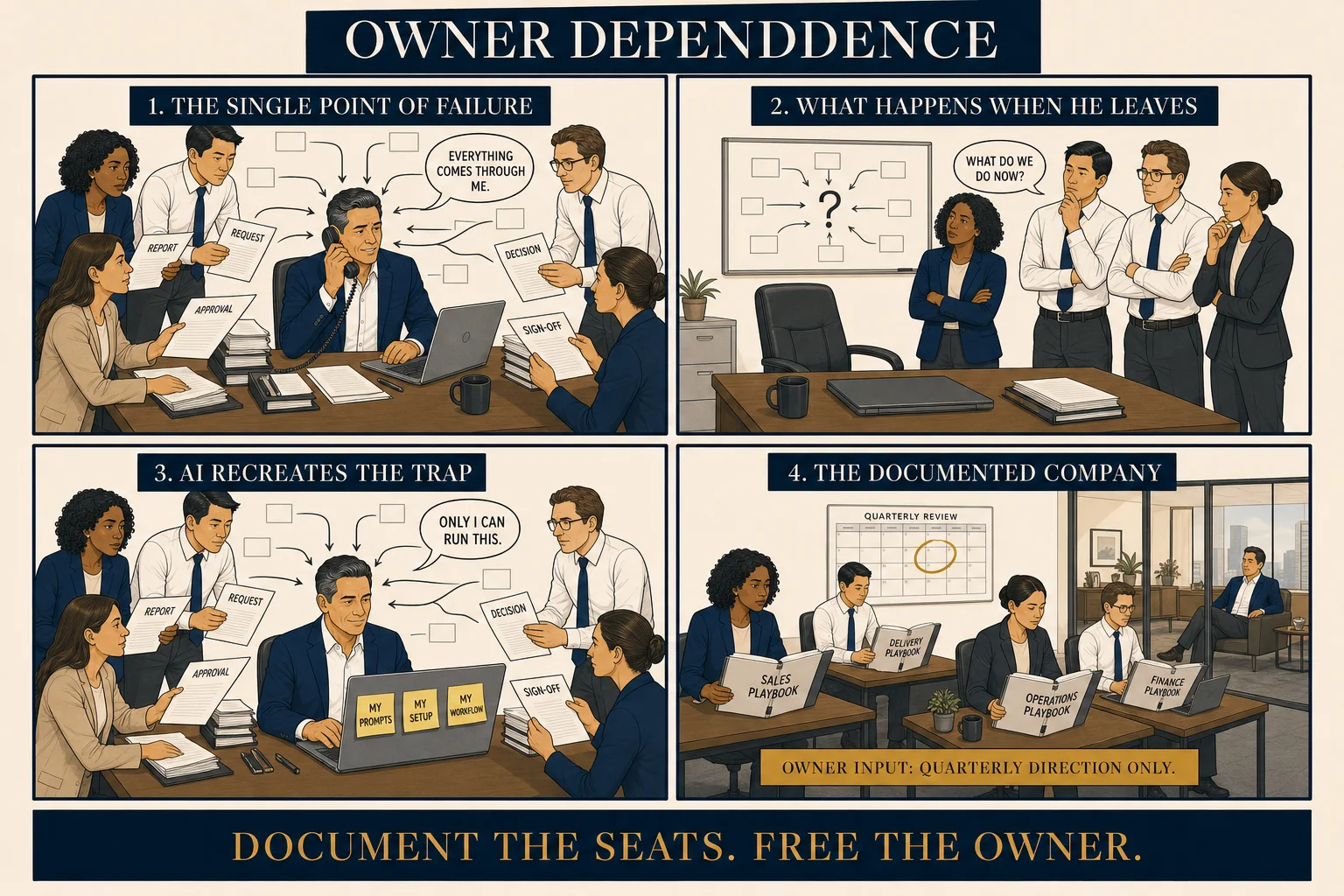
Owner dependence is the degree to which a business relies on its founder for decisions, relationships, and day-to-day operation. The more the company needs one person present, the less of it actually exists as a transferable asset. A company that stops functioning when the owner leaves is closer to a job than a business, and its value is really a bet on whether that person stays.
The useful contrast is between owner-operated and turnkey. In an owner-operated business the founder is in the work, holding sales or fulfillment, so those duties are load-bearing and personal. In a turnkey business the team and the systems run the company. The closer you sit to turnkey, the more durable, and the more valuable, the company is.
Why It Caps Value
Owner dependence is not one weakness among many. It sits underneath the others. Recurring revenue, a real management team, customer relationships that do not run through one phone: each is a way of saying the cash flow survives the departure of any single person. Value that is lodged in a founder personally is value that cannot be counted on, so it is discounted. Reducing dependence is not just defensive housekeeping. It compounds, because it makes every other strength real.
AI Recreates the Trap
The new wrinkle is that AI does not automatically reduce owner dependence and can quietly increase it. When your AI leverage lives only in the founder's head, in one clever person's private workflow, or in prompts that exist on a single laptop, you have built a fresh single point of failure rather than a durable advantage. Leverage one person can carry out the door is fragile by definition. Real transformation puts the leverage in the process, checked in and reproducible, so the company owns it rather than renting it from an individual. See Own the Substrate and the Organizational Truth Repo.
Seatify Yourself
The practical work is to treat your own role as a set of seats to be filled. Name every function the company routes through you: the key relationships, the decisions nobody makes without you, the operating knowledge that lives only in your head, and now the AI workflows only you understand. Each of those is a seat. Define it, document it, and put a person or a system in it, until no single human is irreplaceable.
Founder-led companies hide this dependence behind loyalty and charisma. People stay because of you, customers call because of you, the team waits on your desk. That feels like strength while you are there and reads as risk the moment you are not. Converting personal heroics into a transferable, documented asset is the whole point, and it is the same work whether your goal is a more resilient company today or a more valuable one later.