AI Transformation Is Digital Transformation, Accelerated
Digital transformation has been the goal for decades: make data the primary commodity in your business so you can continuously improve it. AI didn't change the destination. It changed how fast you can get there, and how high the ceiling goes.
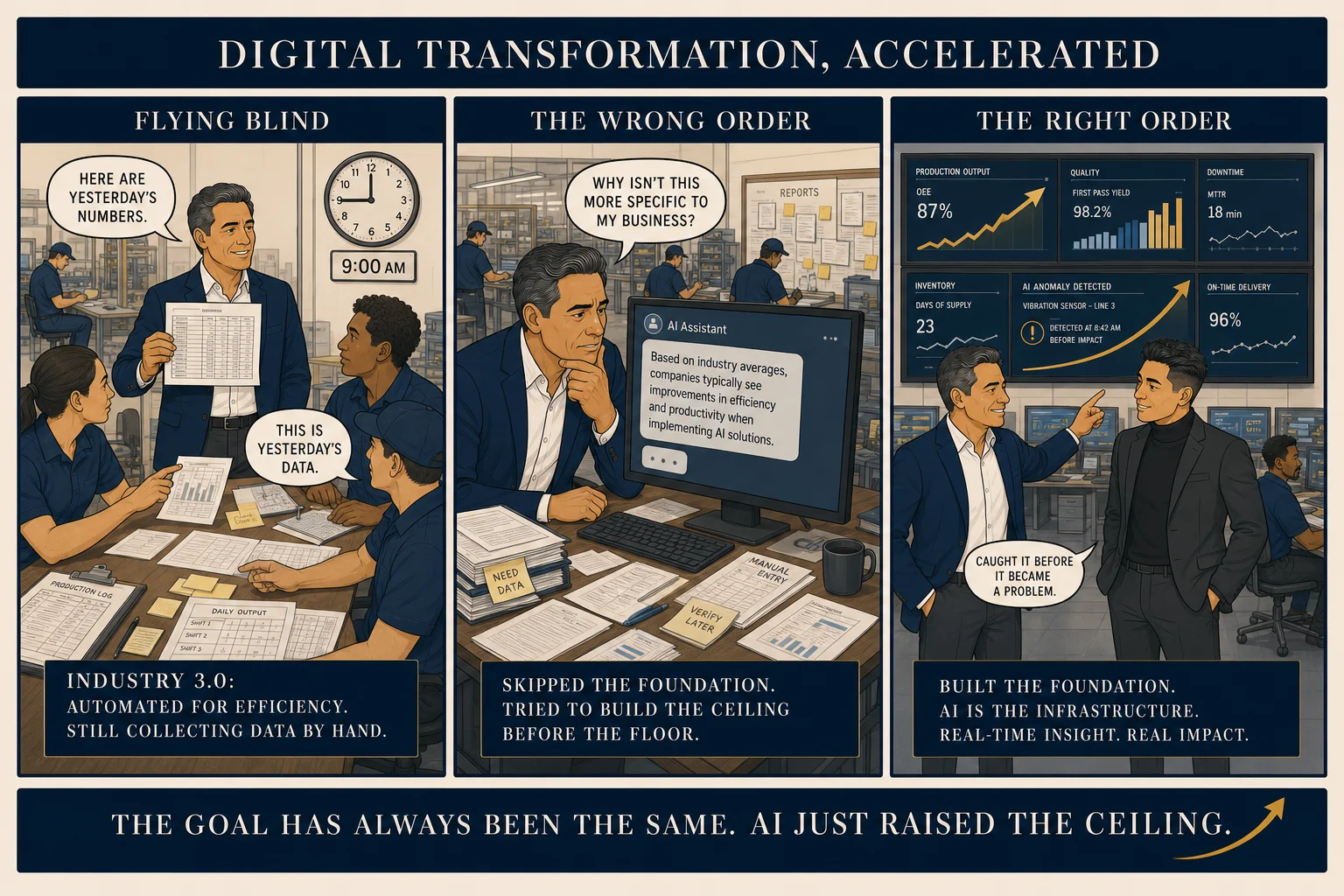
The term "digital transformation" has been around for decades. Consultants have been selling it to manufacturers since before most business owners had heard of it. But the core idea behind it is exactly the same goal behind what people now call "AI transformation." Understanding that connection matters, because it tells you something important about where you are and what you need to do.
The goal has always been the same
Digital transformation, at its root, is a strategy for making data the primary commodity in your organization. Every other part of the business serves that goal. Tesla is a data company that happens to sell cars. Amazon is a data company that happens to ship packages. Tesla's most profitable business line is insurance, not because they are good at insurance, but because they know exactly how every driver drives. They collect real data on actual risk. Allstate and State Farm are guessing. Tesla is not.
That is data as primary commodity. And for decades, the most forward-looking manufacturers and operators have been trying to get there.
AI transformation is that same destination. The difference is that AI changes two things: how fast you can build the infrastructure to get there, and what you can do once you arrive.
The problem almost every business starts with: they are blind
Here is a diagnostic question. Ask yourself right now: what is the biggest bottleneck in your operation this week? Where is time being lost? How many errors or rework items happened in the last seven days? What does your team actually spend most of their time on?
If your best answer is a rough estimate, a feeling, or a spreadsheet someone filled out yesterday, you are in the same position as most businesses. You are flying blind.
This is not a character flaw. It is the default state. The reason most businesses cannot answer these questions precisely is that they rely on humans to collect data, and humans are bad at collecting data. Not because people are lazy, but because data collection is not what people are for. When a supervisor runs a morning meeting and reviews last shift's spreadsheet, they are looking at data that is hours old, filtered through memory, and shaped by what people chose to write down. The resolution is low. The picture is late. And the problems hiding inside it stay hidden until they get large enough to be obvious.
Industrial operators have a phrase for this: they say the company is "industry three," automated for efficiency but still collecting information by hand. The best-run version of an industry-three company is still guessing at its own current state.
What transformation actually builds
The first step of any real transformation, whether you call it digital or AI, is the same: get current state. Know what is actually happening in your business right now.
That sounds obvious. It is not. Getting to genuine, real-time visibility into your own operation is the first twelve weeks of work for nearly every company that undertakes this seriously. Once you have it, you can do something powerful: store it. And once you store it, you can start finding patterns.
The sequence looks like this:
- Current state. Real-time visibility into what is happening. Not yesterday's spreadsheet.
- Historical record. Store that current state over time. Build a clean record of how the business actually runs.
- Pattern detection. Once you have history, you can spot anomalies: things that went wrong, things that went right, and the signals that preceded both.
- Prediction and improvement. If you know the patterns that led to a problem, you can catch them earlier next time. Eventually you get ahead of the problems entirely.
That arc (from blind to visible to improving) is the transformation. It is what turns a business from one that reacts to problems into one that anticipates and improves continuously. Continuous improvement is the destination. Getting there requires data you actually trust.
Where AI changes the equation
AI does not change the goal. It changes two things.
First, it speeds up the build. The infrastructure that used to take a large team, custom software, and expensive integrations to assemble can now be built significantly faster with AI-assisted development and the new generation of agentic tools. What used to be a multi-year initiative for a large manufacturer is now a realistic goal for a smaller operator.
Second, it raises the ceiling of what the transformed state can do. A business with good data infrastructure can now embed AI agents directly into its operations: agents that monitor current state continuously, surface anomalies before they become expensive, and make recommendations that a human then acts on. The business stops being something you run and starts being something that runs and improves. That is what buyers are pricing when they pay a premium for an AI-embedded business.
Why only one in twelve actually make the jump
A practitioner who has worked in industrial digital transformation for eight years puts it plainly: only one out of twelve companies that set out to digitally transform actually complete the journey. He has been tracking this number across M&A data for eight years. It has not improved.
The reason is not technical. The reason is that the journey starts with an uncomfortable truth: you do not know your own business as well as you think you do. The first thing transformation requires is admitting that the data you have been collecting (by hand, in spreadsheets, through shift meetings) is not good enough to build on. That admission is harder than it sounds, especially for a leader who has run the business successfully for years.
The leaders who fail are usually the ones who skip the current-state step because it feels too basic. They want to start with AI, not with data hygiene. They want the ceiling before they have built the floor. That is the wrong order, and it is expensive.
The leaders who succeed start by accepting that they are blind, building the visibility they need, and then climbing from there.
What this means for a business preparing for exit
A business that has made this journey (real-time visibility into its operations, a historical record it trusts, and AI embedded into how it runs and improves) is a categorically different asset than one that hasn't. The difference is not just operational. It is visible to any buyer who looks closely at how decisions get made and how problems get caught.
AI now decides what your company is worth. And the thing that drives the premium is exactly what digital transformation has always been building toward: a business that knows itself, improves continuously, and does not depend on heroic human effort to hold it together.
Further reading
- What AI Transformation Actually Is
- The Organizational Truth Repo
- Data Is Not Information
- AI Now Decides What You're Worth
- Get Clarity Before You Transform
Sources: 4.0 Solutions, "What is Digital Transformation (2026)."