Data Is Not Actionable Signal
A well-designed modern business system surfaces one-off opportunities for leadership to improve it: the bottleneck forming, the drift, the opening. Raw data becomes that signal only when a leadership-approved model defines what success is and what is worth flagging.
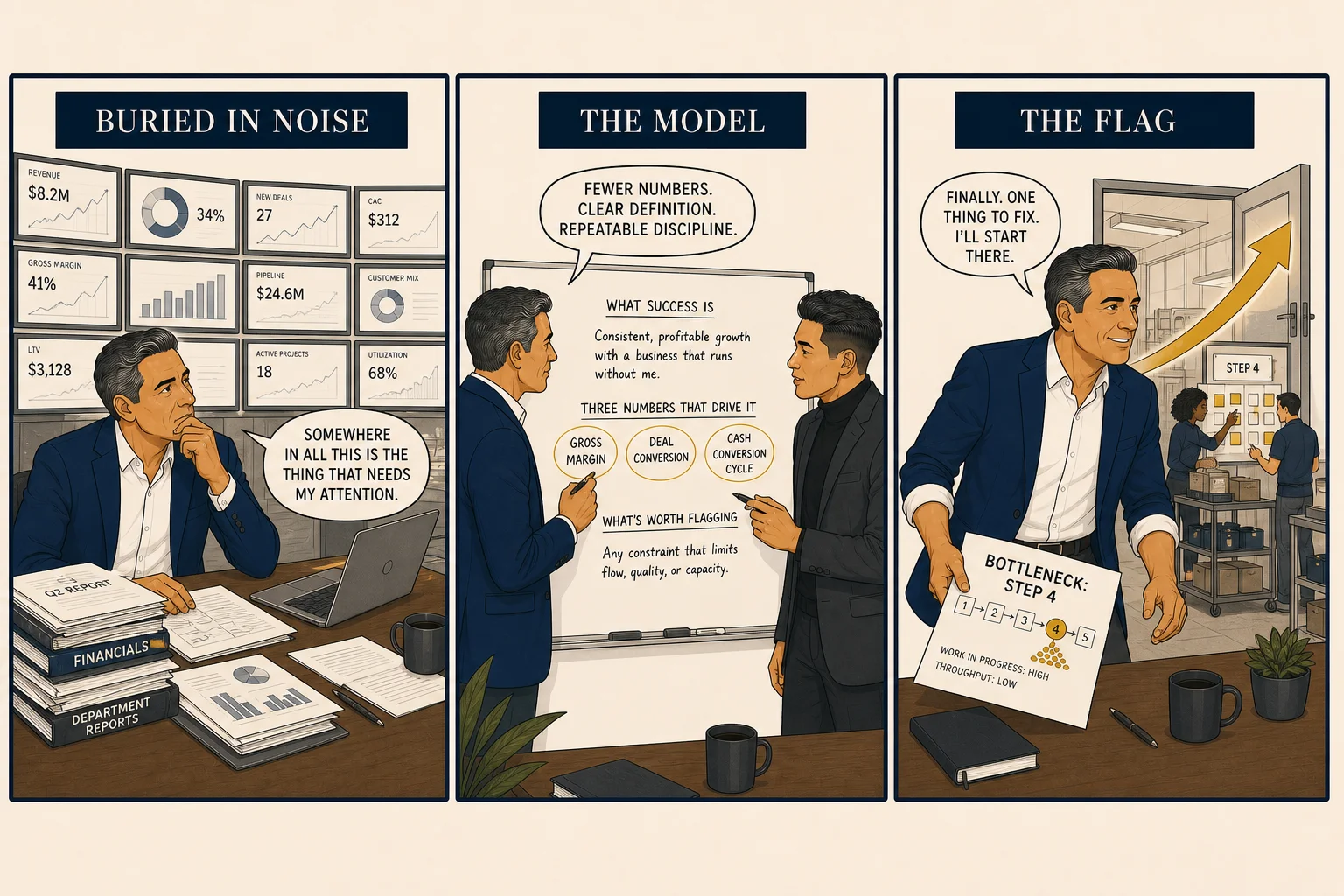
The gap between data and signal
A company can have every system humming and still not be able to answer the question that matters: where, specifically, should leadership intervene right now to improve this business. The numbers exist. The answer does not.
That is because data and actionable signal are not the same thing. Data is what the company records: logs, exports, cost rates, cycle times, alarm histories. Actionable signal is the business flagging one specific opportunity: what is happening, why, and what is worth a leader's attention. Most operations are stuck in the gap between the two, and leadership compensates by watching everything personally.
What the signal is actually for
The point of closing the gap is not better reports. It is routing strategic energy to the highest-leverage work: improving the system itself.
The team runs the day-to-day loops; that is normal operations and not the problem. The problem is the work above those loops. When the business cannot tell leadership where attention is needed, leaders have to hunt for it: sitting in every meeting, reading every report, watching everything because anything could be the thing. The improvement opportunities are in there somewhere, buried in the noise.
A well-designed system in 2026 does that surfacing itself. It monitors the operation against a defined model of success and flags the one-off moments worth leadership's energy: a bottleneck forming in fulfillment, a metric drifting from target, a constraint that just moved, an opening a competitor has not seen. Leadership steps in, fixes the system at that point, and steps back out. The fix compounds because it is a change to the system, not a one-time save. That is high-leverage decision-making: strategic humans spending their hours where the model says the system can be improved, not where the noise is loudest.
What closes the gap: an ontology
The missing ingredient is not more data. It is a model — an ontology — that defines which objects matter, what success looks like, which measurables actually drive it, and what kinds of deviations and opportunities are worth flagging.
Without that model, a metric is just an observation. A dashboard full of observations with no defined relationship to success is not a signal. It is noise formatted to look like insight, and it leaves leadership hunting through the noise because nothing says which numbers deserve their energy.
Crucially, only leadership can ratify the model. The ontology claims what the operation exists to accomplish. That is not a technical decision. When leadership does not make it explicitly, teams develop private versions — the same number meaning different things in different parts of the organization. AI layered on top of that produces the "confidently wrong" problem: analytical-looking output that is systematically measuring the wrong things.
Why it decides whether AI is worth anything
The standard assumption is that having a lot of data means AI will work. The opposite is closer to true.
Point AI at scattered, undefined data and it generates confident, generic output, because there is no coherent model for it to act on. AI does not convert data into signal by magic. It needs the operation to be legible first: the right objects defined, the success criteria set, the load-bearing measurables identified and made current, the conditions worth flagging named.
This is the same point underneath the Organizational Truth Repo. The repo is where the ontology lives — the leadership-ratified definition of what the company is trying to accomplish and how the work relates to it. Skip that, and every AI tool added is just another system producing confident noise about an operation that was never made legible.
Load-bearing measurables vs. cheap observations
Most dashboard numbers are cheap to collect and change nothing when they move. The goal is identifying the few metrics the operation actually runs on — the ones where a shift in the number means leadership should look, and tells them where.
Getting there requires the unglamorous work of: defining what success means, identifying which numbers actually drive it, connecting the sources, making the data current enough to act on, and deciding in advance which conditions warrant a flag to leadership. Done well, the test is simple: the business can answer "what is happening, why, and where can you improve me" without a leader hunting through dashboards for it. That is what separates managing the moment from managing the average, and it is what lets the people who own the system spend their energy improving it instead of searching it.
It is also the same legibility work that makes a company transferable. See Documentation Equals Transferability.